On Climbing Mt. Rainier
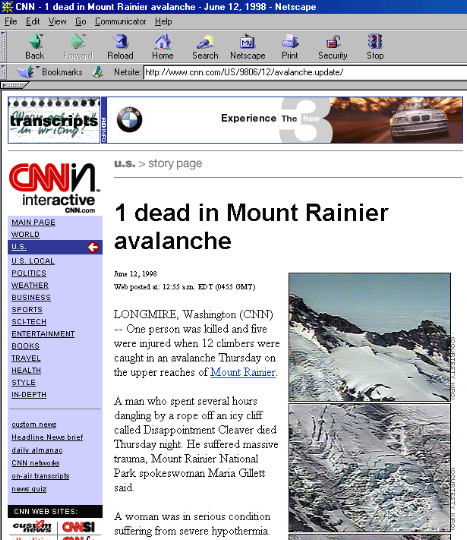
by Daniel McGauleyIt was June 12, 1998, only three weeks before I’d be leaving to climb Mt. Rainier for the first time in my life. I was at my computer checking my email when I decided to take a quick gander at CNN’s Web site before I logged off for the night. There it was. The top headline read "1 dead in Mount Rainier avalanche." I couldn’t believe my eyes. I had to read it again. Yep, I hadn’t misread it. Some poor sap had died in an avalanche at the top of Disappointment Cleaver, a piece of rock separating two of the more prominent glaciers on Mt. Rainier. I recognized the name of the rock from all the books I had been reading on Mt. Rainier. I wasn’t frightened at all about the headline, I was just plotting how to keep this little news event hidden from my wife ... and more importantly my mom.
June 12, 1998, CNN headline 3 weeks before my climb of Mt. Rainier
I looked over my shoulder at my wife to see if she’d seen me looking at the headline. She hadn’t. Good. Of course, she looked at me right at that moment to see why I was looking at her. "What?" she asked. I said "Nothing," and went back to looking at the computer. I had minimized the Web site and forgot that I’d already closed down my mail program, so there I am staring at a blank screen. She walked over and asked what I was doing. "Oh nothing, just checking my mail." "What’s that?" she asked as she noticed the minimized window at the bottom of the screen. You see, CNN does the wonderful job of including the headline in the main title of the Web page you are looking at, so when the window is minimized, you can still read the title on the Windows taskbar. Oops. She was none too happy. It took a while to calm her down and then the questions started. Where had they died? On my route. Damn it. Why’d the poor sap have to bite it on the exact same route I was on? I’m usually quite tactful with my words, but I was at a loss here. What could I say? I couldn’t reassure her that climbing was safe, since I’d never climbed before. And now I really couldn’t reassure her, because that bastard had died doing the exact same thing I was about to do; same school I was going to, same route, same time of year. Damn it. I knew this climb was going to be a lot more difficult then I’d thought.
This wasn’t going to be my first time climbing Mt. Rainier. It was going to be my first climbing ANYTHING in my life. Actually, it was going to be the first time I’d ever tried anything truly dangerous or physically demanding in my entire life. Back in high school, I was in the Marine Corp Junior ROTC program and was in great shape. I even passed all the tests to get into the Air Force Academy and had received my congressional nomination as well, but I was denied several weeks before leaving due to a stupid asthma attack I had at an early age. The military’s attempt to prevent spending a lot of money on someone only to have them die in a billion dollar plane crash because of a freak asthma attack, I guess. Earlier that year, I had gone against my mother’s wishes and dropped a few classes in order to join the baseball off-season. My mom is a registered nurse in San Antonio, Texas, and needless to say, she’s the most paranoid of mothers. Not only does she have the normal motherly worries, but she also has the pleasure of watching young kids coming into her operating room dying of stupid accidents. I dropped the classes, and took them through correspondence courses. I did great in baseball off-season, but eventually didn’t make it on the team, however, it was a very fulfilling and rewarding experience. After the Air Force’s denial and the eventual rejection for the same reason by the navy of my very sought-after Naval ROTC scholarship, I resigned to the fact that I wasn’t meant to have a very physical future.
Eight years later, after paying off all my college debt, I was able to start looking at extracurricular activities once again. I wasn’t always a climbing aficionado. I used go rappelling almost every weekend back in high school, which is basically the reverse of climbing, but I’d never really rock climbed. This Rainier climb was going to be something completely different for me. I’d never been above 6000 feet in my life, so Rainier’s 14,411 foot summit was very enticing. I’d settled into a great job at Motorola and was looking for something a little more stimulating to get my life juices going again.
Around 1995 I started reading mountain climbing books. There were really great. My mom actually got me into mountain climbing by sending me books that she had enjoyed. She’d been an armchair mountain climbing her whole life. After the tragedy on Mt. Everest in May of 1996, mountain climbing began to seem like an interesting way to spend a few days a year. My mom didn’t know anything about my desires to climb, so we shared all of the information that we could on climbing, and especially the tragedy. Now that an avalanche had taken the life of a climber on the same route I was climbing in a few weeks, I was doing everything I could to avoid my mother’s calls. She finally got through and didn’t have much to say. She was pretty upset that I was about to attempt this "foolish" thing, and told me just not to talk to her about it until it was over with. Cool, I could handle that.
About 6 months before my climb, a friend at work by the name of David Valenti had heard I was going to climb Mt. Rainier. We are both around the same age, so we bonded quickly and decided to try it together. We arranged the schooling with Rainier Mountaineering’s infamous climbing school, and booked our flight and hotel room. We’d be staying at Paradise Inn, right at the base of Mt. Rainier and across the street from the climbing school.
I weighed about 225 pounds the summer of 1997. I’m 5’ 9", so that’s pretty overweight. The climb was quite motivating for me. I ran and walked constantly to prepare myself for the climb and got myself down to 190 pounds in 7 months. Not quite where I wanted to be, but definitely better then before. Dave is a slender, 180 pound guy that acts like he’s overweight, but I don’t have a clue where he could possibly be hiding it. It gave us something to talk about at work as we both attempted to "train" for this climb. I don’t know how one can truly train for a climb up Mt. Rainier in Illinois. This place is about as flat as a pancake. We did what we could, including stairs, walking, running, bike riding, etc., but it still didn’t feel like nearly enough. I set a goal for myself. If I could get to Camp Muir at 10,200 feet, I’ll be very very happy and consider the climb a success. Anything more is just great, but not necessary.
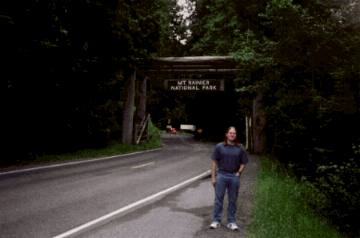
Entrance to Rainer National Park, July 4, 1998
We left for Mt. Rainier on July 4th. We arrived at Seattle/Tacoma airport early in the afternoon and drove straight to Rainier National Forest. The weather was pretty crappy and visibility was very low. We decided to try seeing Mt. Saint Helens, but it was futile. We drove all the way to the point where you should be able to see the devastation left by its eruption, but we didn’t see squat. It was a bit disappointing, because it took forever to get to that point and with the visibility the way it was, it was going to be a long trip back to the fork to Rainier. We eventually got to the ranger checkpoint at the base of Rainier, and I was excited as could be. Moments earlier we had picked up our final equipment rentals from the Summit Haus, a store owned and operated by Peter Whittaker, son of the famous climber Lou Whittaker (who owns and operates Rainier Mountaineering Inc.). Driving up the side of Rainier was somewhat anti-climatic. It was about 40 feet visibility, so we couldn’t see anything. After about 40 minutes of slow driving, we arrived at Paradise Inn. It was drizzly and cold and the altitude of 5000 feet was already taking its toll on us sea-level dwellers. We quickly got our stuff inside our small, comfy room and started getting our gear ready for the next day’s training seminar. It was a shame we couldn’t see the mountain yet, but we figured we’d see it in the morning. What’s funny, is we really didn’t even know exactly what direction the mountain was at that point, but yet we were 5000 feet up it!
Paradise Inn is a wonderful place to stay if you are ever in the area, but it is only open part of the year since snow covers the entire place during the winter (pictures show the place COMPLETELY covered in the winter which is scary because it’s a pretty tall building). The rooms are small, but very cozy. It would be a great place to take my wife sometime, as long as I’m not planning to climb while she’s there. We finished our packing and ate a terrific dinner at Paradise’s restaurant. We decided to hit the hay early because we both knew the next day would be draining.
We awoke pretty early and made final preparations for the training day. We looked outside our window and still couldn’t see the mountain. It was bit disappointing, but I was excited about the training day ahead, so I forgot about it. The three-day summit climb consists of one full day of training, followed by a two-day climb of the mountain. The first climbing day entails going from 5000 feet to Camp Muir at 10, 200 feet. The second day culminates with a climb from 10,200 feet to 14,411 feet and all the way back down to 5000 feet. That’s pretty remarkable considering Mt. Everest climbers typically only move 1500 – 2000 feet a day.
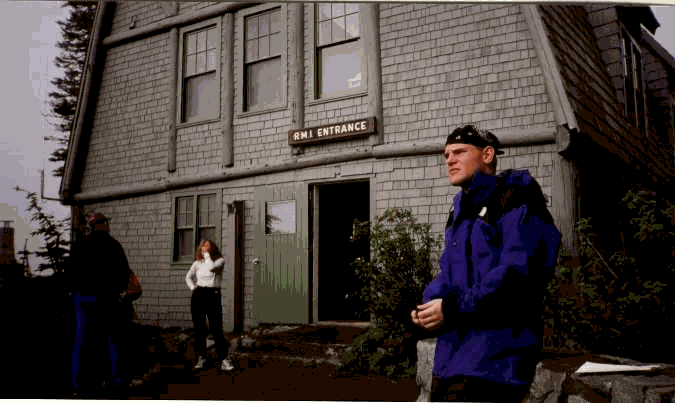
Dave Valenti in front of the R.M.I. Guide House
We met outside the Rainier Mountaineering Guide House. It was pretty exciting. We were about to meet the people we’d be climbing with, and we’d be meeting our guides for the day. There were tons of people mulling about, some of them in our school, and some of them getting ready to make their summit climb that day. It was exciting watching as the summit climbers made off up the mountain. It’s kinda corny, but it’s sort of like watching men and women go off to war. I’ve never been witness to that event before, but it’s what I imagine it would feel like. I knew that these people were leaving for something truly difficult and dangerous and that some of them may not be coming down the next day. What’s even scarier is that I knew I’d be doing the exact same thing the next day.
We got inside the guide house and got the final bits of gear that we needed, including boots, crampons (metal spikes that attach to the bottom of boots for climbing on ice), ski poles and the miscellaneous last pieces of clothing. We also had to register for the school which felt like it took forever, mainly because we were all excited about getting on the mountain. Soon after, we meet our guides for the day. There were about 4 or 5 of them, and most of their names escaped me, because I was too busy thinking about what the day ahead was going to bring. I was nervous as hell. I wasn’t quite sure if I could even handle the training day. I read a book shortly before the climb called The Measure of a Mountain by Bruce Barcott that describes the process of climbing Mt. Rainier with the Rainier Mountaineering climbing school. The author states that if you don’t perform well on training day, they don’t even let you try the summit climb. How embarrassing! I could only imagine what that would be like if Dave got to climb on summit day and I had to wait in the car (we hadn’t booked a room for the night that we’d be on the mountain). The thought of it sent shivers down my spine. I wasn’t really nervous about dying or getting hurt, I was just nervous about looking stupid.
The guides all introduced themselves. Some of them had been on Everest before which was pretty cool. All of a sudden you realize you are really amongst greatness when you learn that your guide was on the original successful Everest climb in 1953. One of our guides, Gombu Sherpa, had actually been the first climber to successfully summit Everest twice. We didn’t really learn each other’s names that day. I guess because some of us wouldn’t be climbing the next day and it would be more embarrassing if we actually knew those peoples’ names. We got our packs on and got out onto the snow for the first time. They needed volunteers to carry the 40-pound ropes. I thought hell no, I’m not going to carry a rope, although I was the one closest to them. I didn’t want any disadvantage during this climb, but I guess it would have made it easier for me to whine later if I were carrying the extra 40 pounds on my back. In the end, I elected not to volunteer. I was worried enough about getting my fat-butt up the mountain, much less a stupid 40-pound rope. Dave volunteered to carry one of them. Bastard! He must really have been feeling good.
We set off up the slopes of Mt. Rainier, still without actually being able to see the dang mountain. The pace was rather fast and after 15 minutes we rested. While we rested, the guide leader explained that he was going to set a super-fast pace up the next stretch to weed out any people who really shouldn’t be there. Great, I thought, I’m a goner. The worse thing about something like climbing a mountain for the first time is that you don’t have a clue what it entails. I didn’t know how long we’d be going at that pace, I didn’t know if the slopes would get stepper, I didn’t know if I would pass out at any second. The pace was quite intense, but not unbearable. The mind tends to focus on the bleeding obvious when you are climbing, like "God, does this suck." The guide also taught us how to pressure breathe which is a way to help breathe in the thinning air up on the mountain. It involves forcing air out of your lungs through pierced lips, making a sort-of whooping sound. I didn’t have a clue how that would help, but I didn’t care, I figured I’d whoop all the way up that damn mountain if they thought it would help. Pressure breathing is sort of weird, because it’s pretty loud, and it sounds like you are struggling for air, but when everyone is doing it, it seems natural. Nobody was really doing it though. I guess because it made them look like idiots. After about 30 minutes of climbing I noticed everyone was pressure breathing. Not only does it help with the thinning air (still haven’t figured that one out yet), but it forces you to really concentrate on each and every breath. It also allowed those of us who were really struggling for air, the opportunity to blend in easier with the rest of the group. Right at the moment when I really wasn’t having a fun time at all, we stopped and the guide leader said we’d be stopping here for training. Thank god, I had made it this far at least.
I knew a little bit about what we’d be doing on training day because I’d read all the books I could find on Rainier. I was pretty excited about it. We started off by putting on our GoreTex tops and bottoms. GoreTex is a very slick, water-resistant material that has the distinction of being the most expensive material known to man. Well, not quite the most expensive, but definitely up there somewhere. The purpose of putting them on now was that we were about to be sliding around on the mountain slopes, and the gear would not only provide protection from the snow, but would allow us to gather some speed as we practiced falling down the mountain.
We started by practicing falling on our stomachs. This would happen if you are walking up the mountain and fall forward and start to fall. It’s pretty easy to stop your downward motion if you can hold onto your ice axe, but once you get some speed going, it’s almost impossible to stop a fall, so you have to start self-arresting as quickly as possible. We practiced by getting on our stomachs, feet pointing down the mountain, with our ice axes in one of either hands (we practiced both). The guide would tell us to start falling and we’d lift up our feet and start sliding, gaining speed every second. Now, one of the most important things to remember when you are falling is to announce that you are falling to everyone else. The point is to warn those around you who will eventually be roped to you, so they can get into a self-arrest position to help stop your fall (and prevent themselves from getting pulled down with you). This is harder then it sounds. We are trained from an early age to hide our mistakes, and now all of a sudden we are being told to announce our mistakes to everyone within earshot. As we all started sliding down the mountain we all yelled "FALLING!" together, and the guide would yell "ARREST!" and we’d grab our ice axes and slam the sharp part into the mountain to stop the fall. After you slow down and get the head of the axe into the ice/snow, you dig you feet into the snow to make three points on the mountain. Two points for each feet and the third point being the ice axe (and your face deep in the cold snow). It’s an awkward position, as your butt is sticking up in the hair and your face is deep into the snow, but it’s supposed to save your life in a fall, so I was eating snow like the best of ‘em. If you lay on the snow rather then getting into the 3-point stance, you are more apt to begin sliding again.
We did that over and over again. I thought we’d continue doing it all at one time like we had started to, but the guides decided it would be best to do it one at a time, I guess so the guides could focus on each person’s attempt. Either that, or because it’s really fun to watch other people yelling "FALLING!" and seeing them flail their arms as they try to stop themselves from sliding further down the mountain. It’s amazing how many people did a great job but forgot to yell "FALLING!" as they started sliding. I guess the natural urge to hide your mistakes is a hard one to overcome.
We moved to our backs, feet aimed down the mountain, and practiced sliding that way. I assumed that if we had our 50 pound packs on that this would have been considerably more difficult, but I hoped I wouldn’t be falling down the mountain at all on the climb, so I figured I’d just have fun sloshing around in the snow for the time being. We learned how to flip ourselves over to our stomachs in a fall like that; sort of like watching a turtle try to get itself back onto its feet after an accidental flip. We then moved to practicing falling face forward down the mountain.
Falling face forward is a bit more intimidating, not only because you are in an awkward position, but also because you are seeing the danger ahead of you as you are falling. It’s also more embarrassing to practice in front of a group of people. You start off lying on your stomach with your ice axe out in front of you as the guide holds you in place by holding your foot. He then pushes you down the mountain and you do the drill to flip yourself horizontally around to make your feet face down the mountain. It’s all a bit of fun, but not as easy as it sounds.
The final falling drill was the backward, face downhill fall. This fall would happen if you are climbing the mountain and a team member falls behind you and the tension in the rope yanks you backwards along with them; not a very enticing sounding situation. If the other positions were awkward to get into, this one beat it hands down. Not only was the position difficult to get in to, but flipping yourself over onto your stomach and then flipping yourself around to face uphill is pretty hard. It’s very easy to impale your leg with the ice axe, because the maneuver involves crunching your body sideways as you swing the ice axe as far up hill as possible. It’s very easy to miss the mountain with that swing and get something more fleshy. After you dig the axe into the mountain, you use the momentum of your fall to swing your body around to face upwards again. It sounds pretty simple, but as all this is happening, you are gaining speed at an alarming rate, so when you actually get to the point where you are trying to stop, all hell has broken loose. I did all right, but it sure didn’t feel like I was stopping fast enough. After every slide, I’d get up to see how many people were laughing at me. I didn’t notice many, so I felt OK. On my final attempt, the guide told me "Boy, you sure look like you are trying hard." I guess he meant I was throwing up tons of snow when I slammed my ice axe into the mountain. I really hoped he meant just that. If I was feeling embarrassed by the comment, it went away on the next person’s attempt because this person just wasn’t having a good time with this exercise. He started his slide and just couldn’t flip himself around at all, so he ended up just sliding down the mountain a few hundred feet until the slope straightened out. He fought for a while, but eventually he just gave up trying and slid until he stopped. I tried not to laugh, but it was quite amusing. He was a good sport, and eventually did OK with the exercise.
We then moved to cramponing. This is the act of walking on ice and snow with metal spikes attached to the bottom of your boots. The lead guide announced that everyone with their own crampons should meet with one guide and everyone else with another guide. I thought he said everyone with their own ice axe so I ended up going to the wrong group at first and had to run over to the other group at the last minute. They were already halfway done with learning how to lace up their crampons. Great, I hadn’t learned how to lace my crampons, and I was about to try climbing Mt. Rainier. I laced them up as best as I could, but they are kind of complicated, so I just figured I’d learn it later. They were on good enough to last out the training day at least. We practiced walking up and down steep sections of ice. It was fun and pretty exciting imaging being on a precarious piece of ice doing this. The crampons felt reel good slamming into solid ice, just like walking up cement steps. We learned different ways of ascending a hill, including different ways to put your feet and different ways to put the ice axe. One weird thing about walking with crampons is that after every few steps you have to smash the ice axe against your crampons in order to break off any embedded ice. It’s a little awkward, almost like trying to rub your belly and pat your head at the same time, but I understood its importance. If you crampons get filled with ice, then the crampons won’t really grab onto the next section of ice as you climb. So, in between everyones’ pressure breathing whooping sounds, there is the sound of metal slamming against metal. It was a lot noisier on the mountain then I thought it would be.
We finished the training by learning how to ascend and descend together while attached to each other by ropes. It’s seemed simple, but it’s very easy to get caught up in the rope as you perform S-turns going up the mountain. S-turns are made to alternate directions going up a mountain, thereby allowing a direct ascent of a section of a glacier. However, on each turn, you have to switch hands with the ice axe, so the axe is on the upward part of the mountain slope, and you have to step over the rope as you cross over. It’s very easy to slam your crampon onto the rope and force yourself to fall as you try to untangle it in a forward motion. They told us that if they caught anyone stepping on the rope on the upper mountain, they wouldn’t be allowed to ascend any further. No one really got it perfectly, but we all did it good enough to get by. The guide yelled "FALLING!" all of a sudden to see our reaction. We all passed his crappy test and took the next few minutes to clean the snow out of our glacier glasses.
We took a little break to eat, and then we headed down the mountain. The lead guide asked for volunteers to carry the rope down the mountain. I figured I could handle that OK since we were heading downhill, so I volunteered. We began to descend the mountain, and I was happy that I’d passed all the tests. We descended quite rapidly, and I was beginning to notice that we weren’t on the same path we came up on. I wasn’t quite sure because the visibility was still really bad, and I couldn’t see more then 100 feet in front of me. I didn’t say anything and just followed the leader. We got to a steep section of ice that I really didn’t remember, but I figured what the heck. At the bottom of the slope, I noticed no one was walking any more. We’d come to a dead-end and had to ascend the steep slope again. Damn rope. It was getting heavier every step. Not only did we have to climb quite a ways back up the mountain, but we were also doing it at a break-neck pace.
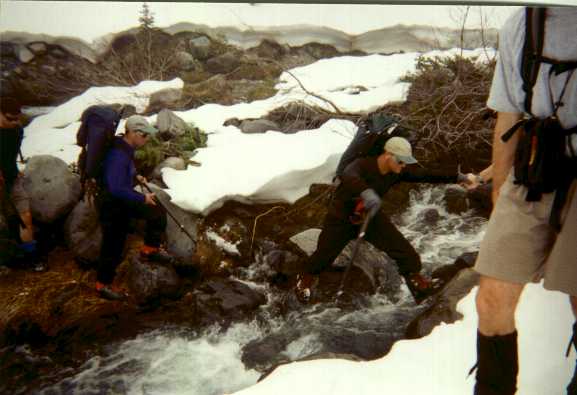
Crossing the streams on the way to Paradise
We eventually started descending again and eventually came across a river. It wasn’t a major river, more of a stream, but it was an obstacle, especially for a fat-boy carrying a 40-pound rope. It’s amazing how much your balance is off when you have a 30-pound pack and a 40-pound rope on your back. Several people fell in the water as they tried to cross the two small sections of stream. I was next to cross. It was a weird maneuver. You had to make a small leap to a wet rock, then immediately jump up to a muddy embankment in the middle of the stream to get ready for the second part of the stream. I had to use my inertia to make the jump to the middle, because it was a little too far to just jump to, especially with the extra 70 pounds on my back. I made the jump fine, but my landing sucked. I got one boot completely in the water, and probably looked like an idiot doing it. The next section wasn’t as bad, but the last step was a 3-foot stretch straight up to the snow edge. Thankfully, several people were extending ice axes to us so we could grab on as we pulled ourselves up. My friend Dave also had a little trouble crossing the river, as did most of the rest of the group. We eventually got to the main road to Paradise and started a couple mile walk back. I walked with Dave and a few people we’d just met. One of the main guides was there too, so that was cool talking with him and learning more personal stuff about climbing. We got back to Paradise, and the guides told us we’d all passed and were qualified to climb the mountain. Thank god I wasn’t cut the first day. I called my wife and my mom to let them know I was still alive. Dave and I ate dinner, packed our stuff for the summit climb, and put the rest of our junk in the car because we’d be sleeping on the mountain the next night.
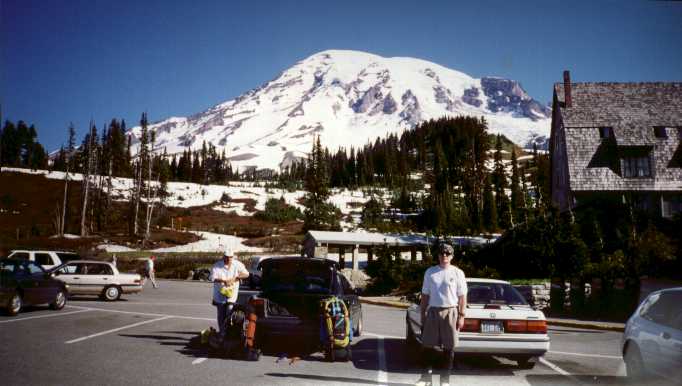
Dan in front of Mt. Rainier on the first day of the climb
We awoke in the morning to beautiful blue skies. We looked out our window and there she was; Mt. Rainier. She was beautiful. I had no clue what it would look like. Dave and I had seen the top of it through the clouds as we flew into Seattle/Tacoma, and that had been intimidating, but now that we were seeing our obstacle only an hour before we were going off to climb it, we were really freaking out. The apprehension didn’t last long, and Dave and I were both pumped to start our attempt.
We gathered at the guide house to register for the climb. There was a new group of trainees there waiting for us to leave. We all registered and sat down to wait for gear inspections. This was probably more stressful then it should be. The guides come around and inspect your packs to make sure you packed everything you were supposed to, and to check that you weren’t too loaded down with silly things like heavy cameras and 10 days worth of food. I had to pee really bad, so I ran over to Paradise to relieve myself. I came back and they’d already inspected most of the packs, so I didn’t have a clue what the process was. I found one of our guides and he came over to my pack. I expected him to open up the pack to see what I brought which would have been a nightmare packing it again, but he just lifted it to test its weight and asked, "Do you have everything?" I said, "Yes," and that was that. Cool. We attached our crampons to the back of our packs since we wouldn’t need them for the first part of the climb, and we put our ice axes on as best as we could since those would only be used on the upper mountain.
The guides introduced themselves. The lead guide was a short, plain looking woman by the name of Heather McDonald. Probably around 28 or so, she had been on Everest twice before. She got within a few hundred feet of the summit the last time, but had to turn back. Very impressive, especially since it was on the more difficult north side of the mountain. George Dunn was the second guide. I recognized his name from many of my mountain books. That was pretty cool, almost like meeting a celebrity. He was very tall, handsome and showed signs of having climbed one too many mountains. Many of the veteran climbers have weird white spots all around their eyes from wearing their glacier glasses on the mountain. George’s raccoon look was the most noticeable. He had been on some of the most famous Everest ascents, and it was an honor climbing with him. George also has the summit record on Rainier. I don’t remember the tally, but it was in the upper 300s. There were a few other guides, including Ashley, a middle-aged man, Phursumba Sherpa, an Everest veteran, and another man who had the summit speed record on Rainier. I can’t remember his name, but he was definitely an athlete. He climbed from Paradise to the summit and back down in less than 6 hours. Something we were going to be doing in about 16 hours. We all introduced ourselves, and told why we were there. There were some very interesting people on our team of 25 and it would have been nice getting to know them better.
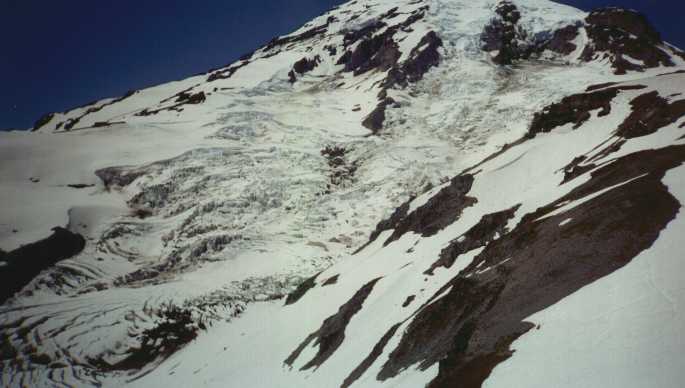
The Nisqually Glacier at the first rest area
We headed off on our climb and passed the newbies (where we were 24 hours ago) on the way out. They wished us luck and we started off on the climb. One of the older climbers from the day before elected not to join us. I guess he didn’t feel so good after the training day. We all started off in a good rhythm, but after about 5 minutes, I realized that I was an idiot for being there. Walking on slippery snow with 50 pounds on your back on a hot day when you are over-dressed is not a lot of fun. They told us we’d be climbing for about 5 hours with 10-15 minute breaks every hour. At least I sort of knew when we’d be resting. That first hour took forever, and we’d only just started. I began to question my intelligence for being out there. When we got to the first rest area, I finally got a chance to stop and look around. Typically, when you are climbing, you are looking straight down at the person’s feet in front of you. Your feet almost immediately land in the person’s tracks in front of you. It’s very convenient because they are "kicking" steps for you to step in to. The lead person has to actually take a hard stride on every step to make the pseudo platform for everyone behind them to use as a step. The rest of the team uses that small platform to step on, so there is very little time for looking around as you look for an empty spot to put your boot. I got to see the Nisqually glacier, a beautiful, stunning slab of ice with thousands and thousands of crevasses strewn all over it. Crevasses occur on glaciers when the ice moves and pieces break away from each other. Some crevasses are hundreds of feet deep, and in the winter are extremely dangerous, because they are often hidden by thin snow bridges. In the middle of July, all the crevasses are exposed, and they are stunningly beautiful. I also got to see Mt. Adams, Mt. Saint Helens, and Mt. Hood in Oregon. They were all amazing looking, their height exaggerated by the flatness of the rest of the terrain around them.
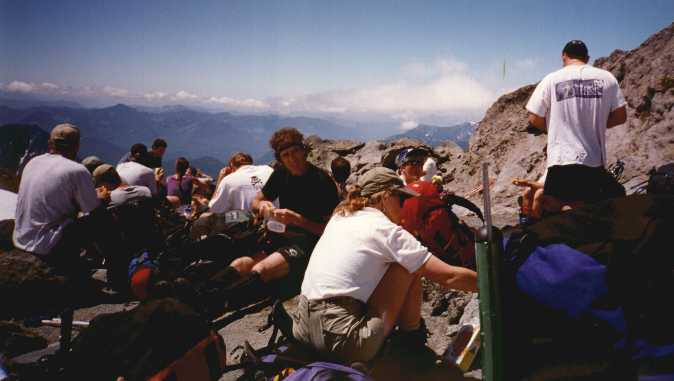
At break #2, Dave is standing at right and Heather is sitting in middle
On each break, we got to stop and eat a little bit. We had a very limited supply of water on the climb, so water is rationed carefully. The poor dude who couldn’t stop himself from sliding the day before knocked over his first of two water bottles. That would suck only having one for the whole climb. I gripped mine tightly as I drank. We were also encouraged to eat at every break, because there are no lunches when you climb. Lunches make climbers tired and groggy, so to circumvent that, we ate small amounts of food at each stop to give us small energy boosts. I had brought some G.O.R.P. (Granola Oatmeal Raisins and Peanuts) and a bag of chocolate candy. I had this bright idea that if I removed all the miniature chocolate bars from their wrappers, then I wouldn’t have to mess with them up on the mountain. Well, the first time I opened my bag, I was surprised to find a bag of chocolate goo. It was difficult trying to eat it, but it was the only desirable food I had brought, so I gobbled down a couple of hands-full of goo.
Our 10 minutes of rest were up and we started getting ready to climb again. I noticed that Nancy, one of our climbers, had decided to turn back. I thought, uh oh, the pressure is off. I can quit whenever I want now and I won’t feel bad! Damn Nancy. I shouldn’t have had that thought in my head, because I went back to it about 500 times over the next 4 hours. Nancy wasn’t in the best of shape, but she was very ambitious and hard working. I was sad to see her go. Oh well, it was time to focus on Daniel.
We took off again and everyone was sort of slow in heading out, so I took off right behind Heather, the lead guide. It was pretty neat climbing right behind someone who was just on Everest a year ago. I could imagine myself climbing on Everest with her. 5 minutes later I was just wishing I were back at home asleep. I said it before and I’ll say it again, mountain climbing is a lot harder then it looks. There are so many things that are miserable about it, but the worse thing about climbing with a school is the fact that you don’t know when you’ll be stopping next or where your destination is. Climbing at your own pace and knowing that you can stop at any point to rest would be much better.
The mountain is so big, that you can’t really tell distances very well. I asked Heather and another guide at the next break where Camp Muir, our destination, was. I felt a little like a kid asking his parents "how much further?" but I wanted to know. They showed me, but they could have been pointing anywhere, and I wouldn’t have known the difference. I just knew I wasn’t having fun. The mind becomes your worse enemy climbing. I couldn’t focus on anything except how miserable I was. I thought about quitting a few times, but kicked myself in the butt to force myself on. Many times, I’d be completely focusing on stepping in the person’s tracks in front of me, when the line of people would stop for some reason and I’d ram my head right into the person’s pack in front of me. That wouldn’t have been so bad, except that our crampons are all attached to the back of our packs, spikes out. I did that about 6 times the entire climb. I didn’t feel too bad because I heard the yelp of many other climbers behind me just as I was rubbing my head.
Another interesting fact on the mountain is that human gases seem a bit more active when you are climbing. I choose to always be as far in the lead as possible, because my short stints in the rear were not very pleasant. It’s not a lot of fun trying to suck in every breath as if your life depended upon it, only to have 60% of it methane.
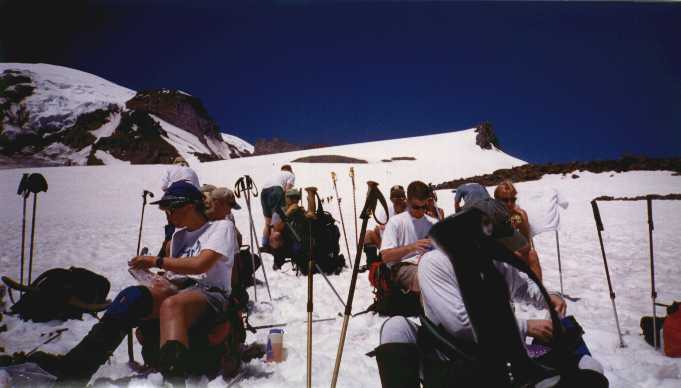
Break 3 on the Muir snowfield
Finally we made it to our 4th and last rest area. The last few rest areas are all on the Muir snowfield. A gigantic piece of miserable, painful snow slopped about 45 degrees. It seems to last forever. It was very refreshing knowing our last stretch was head of us. I knew at that point that I could make it. Only a few minutes ago, I had almost turned back. I was feeling like total crap. My head hurt, my eyes hurt, my legs hurt, I felt nauseous, you name it. Right before the last rest area, I was climbing, and I started drooling, and my nose started running. I had no energy to even care. I knew I had drool and snot all over my face, but I just couldn’t have cared less. George Dunn came up beside me and asked how I was doing. I just looked at him, and I guess the snot soaked face was response enough for him. He told me I was looking strong and I just wanted to tell him to go screw himself, but I knew he was just being helpful. For one brief moment I had felt good climbing next to him, almost feeling like I was in one of the books I had read. However, the good feeling lasted about 1/10th of a second before I was focusing on everything I hated about the climb.
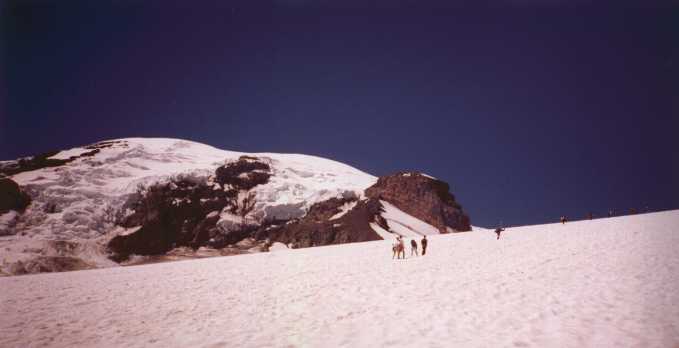
Muir snowfield above the fourth rest area
Everyone seemed to be stretching the last break forever, so eventually Heather took off and a group went with her. I wasn’t moving because no one else in my area was. I was engaged in a conversation with George, not because I cared about what he had to say, but because I just wanted the damn break to last another few seconds. I don’t even remember a word he said to me. I was just making up any conversation I could to sit on my butt for a few more seconds. I eventually realized that the sooner I got to Muir, the sooner I could really relax, so I got up and chased after Heather’s group. The rest of the team followed me. I was sort of in the lead for a bit, because Heather’s group was so far ahead, that we’d actually become two separate groups. I climbed as fast as possible to catch up, but trying to move fast on the 45-degree slope kills your energy quickly. Eventually the group behind me was dropping back a ways, and I was all alone in the middle of the two segregated groups. I climbed the last hour like that and it was sort of peaceful, but it was just as miserable as the first 4 hours of climbing.
After about 50 minutes since our last break, I could finally see Camp Muir. It was absolutely, without a doubt the most beautiful thing I’d ever seen. The last few hundred feet to Muir isn’t what I expected. You never really see it until you are right on it. The slight slope of the hill prevents you from seeing it until you only have about 5 minutes away. That gives you the impression that you are going to be climbing all day to get to this thing. If I could have seen Camp Muir from the bottom of the mountain, it would have helped knowing how much further I had, but now that I’d climbed it, I realized that nothing could have made it easier except a ski lift.
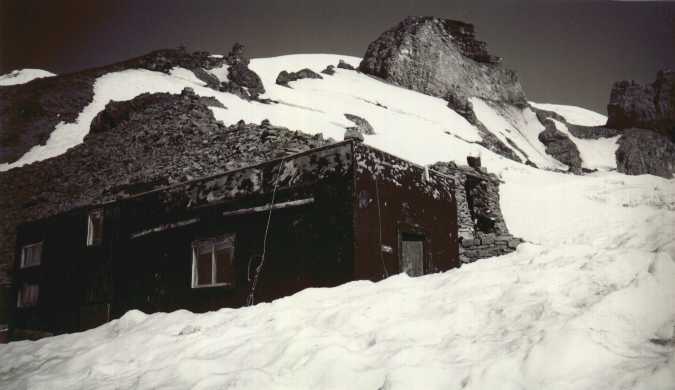
Camp Muir, 10,200 feet. Summit is behind in center and Cadaver Gap to the right
Camp Muir is a miserable looking shack in the middle of nowhere, but it looked like heaven to me. As I approached it, I promised myself that I wouldn’t step a foot above Camp Muir, and tried to make myself remember that promise for later. I had reached my goal, and I was happy; very happy. Training and thinking about a goal for so long feels very fulfilling once it’s accomplished. We relaxed at Muir for a half-hour. It was about 5pm and they said we’d meet in a few minutes, and then we should eat and get ready for sleep. We’d be getting up around midnight or 1am to start the last day of the climb, so we were all anxious to go to sleep to get some rest.
We started the meeting and they told us where to get waist harnesses for the next day since we’d be roped together. They also told us where to get the helmets to attach our headlamps to. Heather told us what to expect the next day and when we’d be waking up. They were going to aim for midnight. They gave us our climbing teams, and I was on Heather’s team. After the meeting, Heather came up to me and asked if I’d switch groups. I told her no problem. I was then put onto Phursumba’s team. I really didn’t care whose team I was on, but I was curious about the change. I learned later that a married couple who had elected to climb Rainier for their anniversary (rather then go to Hawaii), had accidentally been put on the same team. They had promised their families that they wouldn’t climb on the same rope team in case something like three weeks ago happened again. The reality of how dangerous this was came back to me. I really didn’t expect to even climb the next day, but I was starting to forget my promise to myself as I started feeling better. By staying at one altitude for an extend period of time, the body learns to cope with the change in altitude. Acclimatization, even at 10,200 feet, can make all the difference in the world. I was really feeling the affects of traveling from sea level to 10,200 feet in two days, but a few hours at Camp Muir resting had me feeling much better.
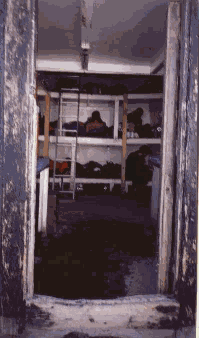
Bunks in Camp Muir Hut
We all sat around and ate our crappy meals. Some people had some fancy stuff and passed it around. We had unlimited hot water from the Muir cooks, so that was nice. I accidentally spilled some of my stew on the wooden counter and felt like an idiot, but no one really saw. I was supposed to let my stew sit for about 5 minutes with the hot water, but I was starving, so I just ate it immediately. It was horribly crunchy, but it tasted great. After dinner, we all got our gear ready for the next day. It was fun packing our gear because we were leaving a lot of it at Muir (like our sleeping bags and ski poles), so our packs lost about 20 pounds. I was really dragging my feet getting ready. It suddenly occurred to me that I really hadn’t seen much of my friend Dave the entire climb. Everyone is in their own little worlds when they are climbing, and I just never got around to talking to him. I went over and asked how he was. He said that the 5-hour climb was hard, but that he was ready for the next day. I told him my reservations about continuing on. I think he called me a wuss or something like that, and told me I was going to climb. Well, if he told me I had to, I guess I had to.
I finally climbed into my sleeping bag around 7:30pm. Everyone was pretty much asleep already, or at least they were acting like it. We were all sandwiched into the Muir hut where there are three levels of boards that we were all lying together on. I was on the bottom row, right next to Dave. I was ready to go to bed, but had to get situated. I passed Dave a breathsaver, which was my way of brushing my teeth up there. He bums them from me at work every once in a while, so he appreciated the offer. A few minutes later, I realized I had to pee. I was cold and not dressed, and it was dark out, and I had to pee. Damn it. I never really went to bed all night because of that, but around 10:30 I started drifting in and out of sleep, but at 11:00pm, Heather came in and told us to get ready to climb. I was pretty excited, because I could finally relieve myself. It was really cold out, but I was just happy I was going to be peeing soon. I actually felt really good physically and mentally. Cold weather always makes me more energetic and strong. I was really ready to start climbing. Screw my promise.
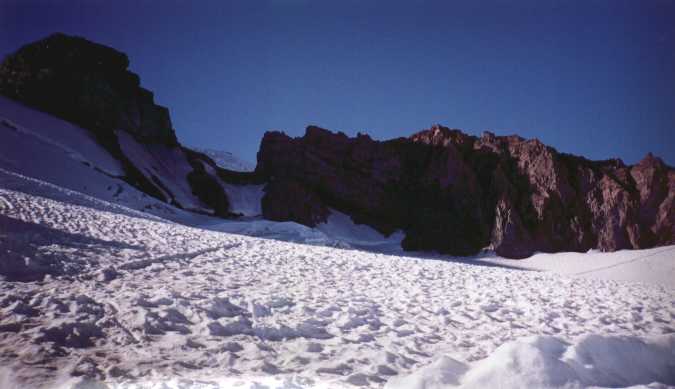
Cadaver Gap with Cathedral Rock to its right on Summit Day 1
The next day’s route is just visible below Cathedral Rock on the right
I ate a quick breakfast and got ready as fast as I could. I got everything ready to go and realized I had never learned how to tie my crampons properly. I started fiddling with them and couldn’t quite get them. One of the guides came over and looked at them for me. "Looks good," he said. I was happy to have finally learned how to tie them, but I was a little unsure of how well the guide actually checked them. Everyone looked pretty neat as they got ready, because it was really dark and everyone had their headlamps on, so there were little beams of light shinning everywhere. I heard my group leader call me in his Tibetan accent. I went over to him and he said we’d be leaving now. I never really got a chance to see if I had anything else in my system, most importantly anything in my bowels that wanted out, but I was feeling pretty good. I got my pack on and went over to my 4 person team. We all hooked up to the rope, and we took off a lot faster then I thought we would. We were the second team to leave, and I realized that my rope was caught under my backpack’s buckle, which was going to be a bad situation if I didn’t fix it. I tried to fix it while I was walking, but I just ended up making it worse. I started freaking out a little, but I finally got it right. I rolled up my sleeves, because I was starting to sweat even in the 10-degree weather, but I quickly got into a good grove and felt great climbing. We were heading right toward a gigantic piece of rock called Cathedral Rock. They had shown me the path that we’d be taking the day before, but all I had seen was a path heading right for the 800-foot rock. As we approached the rock, I looked down at the Cowlitz Glacier that we were on, and I saw my first crevasse up close. The moonlight was illuminating it slightly and it looked terrifying. Like a pit to hell or something. I suddenly realized that one small trip and the crevasse would eat me up before I even got a chance to self arrest. "What the hell am I doing here?" I thought. We got to the base of Cathedral Rock, and I wondered where we’d be going from here. I didn’t realize that we were going to actually climb straight up that rock. There was no snow or ice on the rock, so for 800 feet, you are just climbing on hard rock with crampons on; which is not very comfortable. There are non-stop sparks flying everywhere from every ones crampon spikes striking the solid rocks. We were zig-zagging up the rocky path, so the ropes were getting caught on rocks, and peoples’ crampons. As I was climbing one section, my crampons got jammed into my other crampon, and I fell face forward. My knees stopped my fall, but it really woke me up as to how easy it was to make a big mistake. When I finally got to the top of the rock, I started feeling horrible. The 800-foot ascent in 30 minutes really took its toll on me. I started vomiting and dry-heaving uncontrollably. I got my crampons caught again and fell forward again. This time, we were on the edge of a glacier that dropped off about 3000 feet, so I kicked myself and started focusing more. I was feeling very sick, and had a horrible headache, but I was able to concentrate better after the near miss. The climber behind me (the guy who couldn’t stop his slide during training) was having a tough time too. I kept feeling the rope getting taught, which made me slow down, which made the rest of the team slow down. I got blamed for this about 6 times and wanted to let the leader know I wasn’t doing it, but it sounds like such a bastard thing to yell out, "It’s not me! It’s the loser behind me!" I just kept my mouth shut. After another 10 minutes, I realized that I had Acute Mountain Sickness. All the symptoms pointed to it and I realized my climb was over. I focused all my energy on getting to the next rest area, because you can’t stop in between rest areas. It seemed like it was taking forever to get there. I could see the team in front of me, but their headlamps were all pointing at the mountain ahead, so I knew they were still climbing. I really didn’t think I could go much further, but I focused on the fact that I was going to be done climbing in only 10 more minutes.
I finally saw all the headlamps in front of our group pointing in different directions, including our direction, so I knew they had stopped. I focused on the next 200 feet and finally got up to them. I collapsed on the ground. My leader came by and asked how I was. I told him right up front that I was finished. He felt bad for me and told me to think about it and he’d come back to me. I didn’t have anything to think about. I knew I was done, but I said OK. He came back to me about 5 minutes later and asked how I was. I told him I was OK, but that I couldn’t climb anymore. He asked for more details and I told him how I felt and that I knew I’d be a liability to the team. I told him my goal was to make it to Camp Muir on this climb and that I didn’t care about the summit as much as I did about trying to have fun and get home alive. He gave me a big hug and told me he loved my attitude. I guess most climbers who get turned back are very upset about it. Not me, I was happy as hell that I’d be resting for several hours as my sickness past.
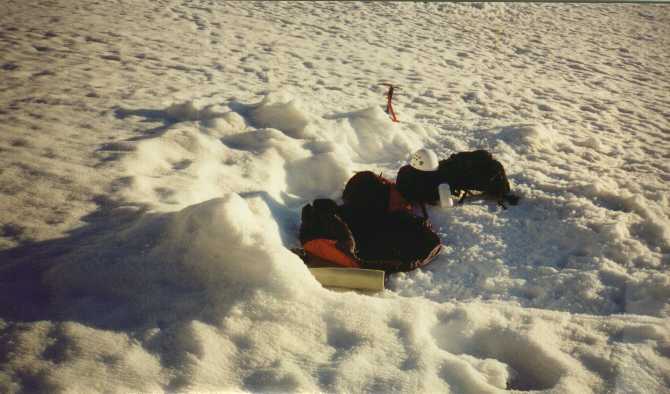
My temporary home at 11,000 feet
I had read in The Measure of a Mountain that when you can’t go any further, they wrap you up in a sleeping bag like a bean-burrito and stuff you into the side of the mountain. I was scared of this embarrassing situation happening to me, but when I got to the sleeping bag, I didn’t care at all about what anyone else thought. I wished Dave good luck and said good-bye to Heather, the group leader. I had a feeling they all hated me because they all wanted to be the ones stopping, about to go to sleep in a warm sleeping bag. I didn’t care, I was just so happy to be alive and done with the pain. I watched them all leave and eventually took off my crampons and boots and got into the sleeping bag.
I was exhausted and still very sick, but the mountain sickness started to drift away. I looked up at the sky for awhile. It was very peaceful. It was very quiet and the sky was perfectly clear. I’m an amateur astronomer, so I took the opportunity to look at the sky, probably the closest I’d be to it for a long time. I was a little hungry, so I got out my bag that had previously contained tons of melted chocolate. It was now filled with the largest chunk of chocolate I had ever seen in my life. The cold had frozen it solid. It was an interesting mixture of M&M’s, Twix bars, Snickers, and other miscellaneous chocolates. I ate a little of it, drank some water, and I finally drifted off to sleep. I awoke about 30 minutes later and realized that my feet were frozen solid. I couldn’t feel them anymore, and what I did feel, didn’t feel good. I knew I had about 6 or 7 more hours before I’d see anyone again, but I couldn’t just lay in the sleeping bag all that time. I finally got out of my bag and put my boots and crampons back on. It took almost an hour to do that.
I had bought a pair of mountain climbing boots from REI before I came to Washington, and I had trained in them for about 6 months prior to the climb. I wanted to break them in as much as possible, because I didn’t want to get blisters halfway up the mountain. When I got to Rainier, the guides told me I shouldn’t use those boots, because they wouldn’t repel water, and my feet would be cold the whole time. It was the only advice I didn’t heed the whole trip, and it came back to haunt me. They were right. My feet were cold and wet from the moment I left the guide house. I had hoped that having them broken in would be more of a benefit then making sure I had warm, dry feet. Everyone else climbing rented their boots from the guide house and didn’t have a problem. As I tried to put my boots back on after letting them be exposed to the elements for an hour was nearly impossible. Not only were my feet achy and cold, but the boots were rock-solid and cold. I finally got my feet back in, but I was cursing the entire time.
I stood up and started to walk around my temporary home. My feet were truly killing me. I grimaced with each step. I walked in circles around my sleeping bag for about 30 minutes to get my feet warm again. It was still very dark out, but it was fascinating watching the row of headlamps heading up Disappointment Cleaver. They seemed to move so slowly. I knew they were starting to get into the really dangerous areas of Rainier. I could actually see the danger from my vantage point. They were about to be walking through a very hairy looking ice fall, an area where a glacier is falling apart and huge chunks of it are breaking apart everywhere. I thought to myself, that must be where the climber died 3 weeks ago. I would find out later that I was right. Several of our guides were there that day trying to rescue him, and they relayed the story to me in sad detail. Poor guy hung off the end of the ice fall for several hours until the water dripping on him from the melting glacier finally doomed him forever. I wondered if he had any family. Perhaps he had a wife back home waiting for his call that night, never expecting that her husband could have actually died on Rainier. The thought scared me, and I felt a huge urge to get down off the mountain and call my wife to let her know I was OK.
After another hour had passed, I started getting pretty bored. I was feeling fantastic, like I had never even been sick. I really wanted to climb, and I was ready to start up again. I wish I could have kept one of the guides by my side until I had gotten better. I was not at all upset that I had stopped. I knew I wouldn’t regret it for a moment when I did it, and I wasn’t starting to feel bad then. I just wish I could have taken things at my own pace. I knew that Rainier Mountaineering had personal guides to take you up Rainier, and I decided that I’d look into it sometime in the future if I ever got over my hatred of climbing that was inside of me at the time. As the climbers got to the top of the Cleaver, I could see their headlamps pointing in different directions. Ah, they must be on a break I thought. After about 10 minutes, a line of climbers started off again, but there were several headlamps still pointing in different directions. For the rest of that morning, that’s all the climbers were to me, headlamps. About 10 minutes later, I noticed that those headlamps were now pointing down the Cleaver. For a moment I felt a small sigh of relief. Other climbs had failed. It didn’t really matter to me, but somewhere inside I felt a little better that at least I wouldn’t have to feel completely unfilled alone. Another hour and a half and I would have company.
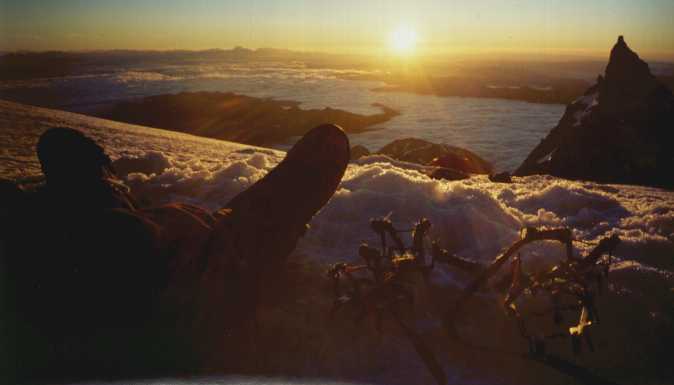
Sunrise at 11,000 feet. Little Tahoma on the right, crampons in foreground
As the sun was coming up, the ice fall really came alive. Everything was so quiet there. All I could hear was the wind, then all of a sudden I heard something that sounded like thunder. I knew there wasn’t a storm anywhere nearby, and then I saw it out of the corner of my eye. A pretty big chunk of the ice fall had slipped slightly, and it had broken off, and the fall had created a monstrous roar. I heard about 10 more of those before the day was over with.
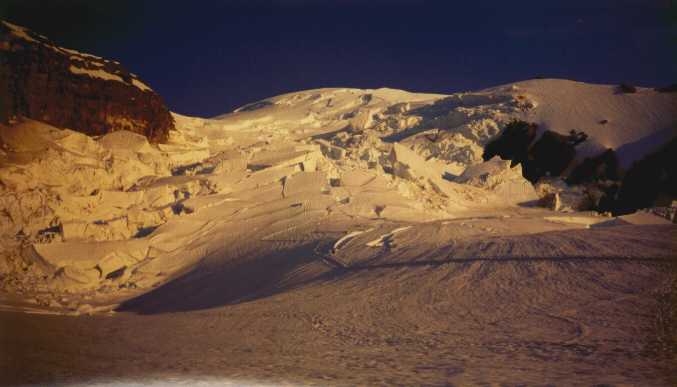
Ingraham Glacier Headwall/Ice Fall (route is visible going off to right)
As I watched the climbers slowly descend the Cleaver, I started taking pictures of the surrounding area. The sun was begging to come up and I knew I’d want to remember how this looked in the future, and I wanted my wife to see what this place was like, because I knew she’d never see it herself. I took pictures over the next few hours that turned out great. Mountain climbing has got to be the most beautiful sport around. It definitely has the best vistas.
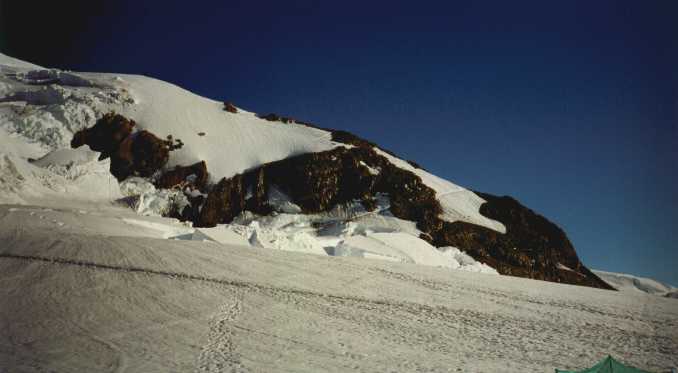
Disappointment Cleaver
The small group of climbers was still about an hour away when I realized I really had to pee. It was still pretty dark out, and I knew I was on a glacier, so I was sort of scared to walk anywhere. I didn’t have the first clue about crevasse awareness. I saw a group of footprints heading off toward the back of Cathedral Rock (we were now on the opposite side of it after scaling it a few hours ago). I figured that would be a safe direction to head since the previous climber obviously thought so. I followed them until the footprints ended and I started the long arduous process of trying to relieve myself in 10-degree weather. I don’t know if anyone actually ever teaches a boy not to pee in the direction of the wind, but I sure wish I had received that lesson when I was younger.
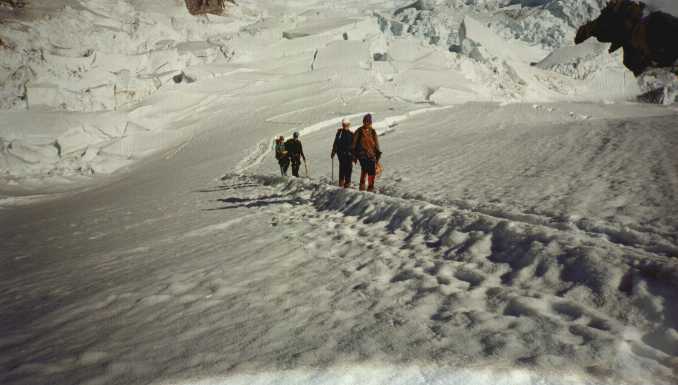
Climbers returning from Disappointment Cleaver
The sun had started to come up and I got some beautiful shots of sunrise over another small peak that’s part of Rainier called Little Tahoma. About 45 minutes later, the descending climbers were within a distance where they didn’t appear as just headlamps anymore. It was actually very exciting seeing them. Wondering why they turned back, who they were, what the climb up the Cleaver was like. It was actually nice knowing I’d have company again. I didn’t sense it before, but I guess I was a little lonely at 11,000 feet. I had taken the time to really enjoy the calm and quiet, but I was ready for conversation. I went up a little ways and got some pictures of them descending. When they got closer, I recognized one of the climbers as the guide Phursumba Sherpa. He yelled out, "HELLO DANIEL!" He had been the one to hug me before the group had left, and he was the first one back. He was followed by two clients and another guide, Ashley.
Phursumba scolded me a little for walking on the glacier unassisted. I really didn’t know what the big deal was, but I guess I really didn’t know anything about glaciers. We all sat and talked a little bit. The clients had really drained themselves climbing the Cleaver, notorious for being the hardest part of climbing that section of Mt. Rainier. One of the clients was Heidi, the lady on her honeymoon with her husband. The other client was a middle-aged man who had retired and decided to start mountain climbing as a hobby. This was his first climb and he was extremely upset and disappointed that he didn’t make it to the top.
We talked for about 30 minutes and they told me how hard the Cleaver was. Thank god I hadn’t tried climbing that. I knew I wouldn’t have made it. We were about to go back down to Camp Muir, when I suddenly realized I needed to relieve myself again. It’s not like I had a urination problem or anything, I’ve just always been nervous since I was a kid that someone would yell at me, "Why didn’t you go before we left?" I went over to the spot I was at before and realized why I knew nothing about crevasses. As I walked over to where I had gone before, I became quite alarmed when I saw my small yellow markings on the ground about 3 feet away from a gigantic crevasse. I guess the footprints were from someone trying to get a better look at the giant hole in the ground, probably during better lighting conditions.
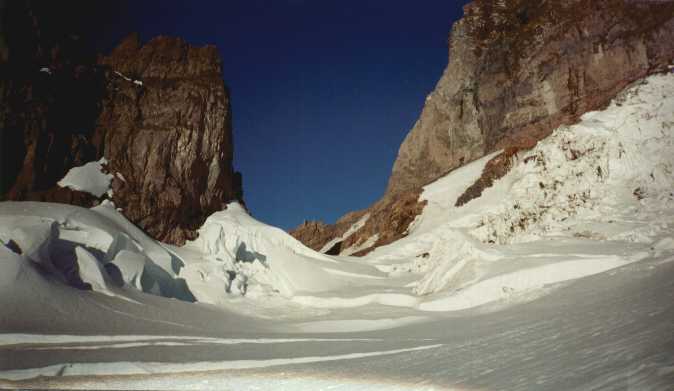
Cadaver Gap (notice the crevasses all over in the foreground)
We all got in a line and roped ourselves into each other and descended towards Cathedral Rock. The view was amazing. On the way up, you can’t really see anything because it’s so dark and you are concentrating on the ground in front of you. On the way down, it’s not as strenuous, and you can take in the view a little more. As we got to the top of Cathedral Rock, I could see Camp Muir in the distance. It seemed so far away. Descending Cathedral Rock was almost as difficult as climbing it. It’s really hard climbing on solid rock with crampons on. It actually seems very dangerous, but I kept my mouth shut. It only took about 45 minutes to get to Camp Muir. Descending is much faster then ascending. I could really get a good view of the crevasses now that the sun was up. They were very scary looking, and I hated to think what one would look like from the inside.
I was in pretty good spirits when I got back to Muir. So was Heidi. She was just happy to have made it as far as she did. I was pretty impressed that she’d gotten that far too. The other client was not as happy and he spent the rest of the day by himself. I felt bad for him, but I just thought to myself the mountain will be here tomorrow. I guess being his age he realized that he really had to start this hobby successfully if he was going to pursue it more. Heidi went to sleep right away, and I stayed outside to take in the view.
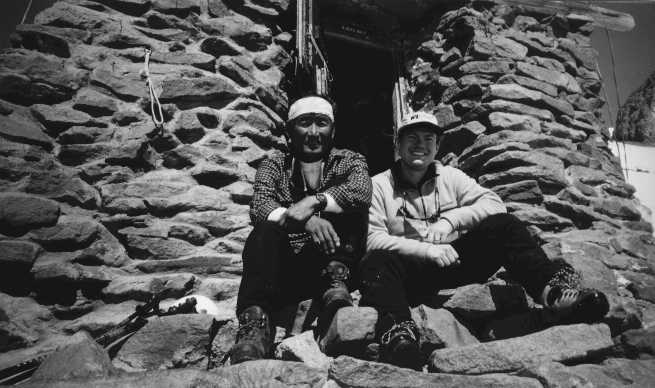
Phursumba and the 11,000 foot failure at the R.M.I. guide hut
Phursumba came over and talked to me for awhile. He told me how impressed he was with how I handled my "failure." He said most people don’t act that way. I appreciated his comments and was flattered when he asked me to join him on a small expedition he runs twice a year to Sikkim, near Nepal. He said he likes to have good spirited people on his trek. I knew he probably really just tries to get anyone to go on the expedition, because it is a business he runs, but I was still very honored and will most likely take him up on it.
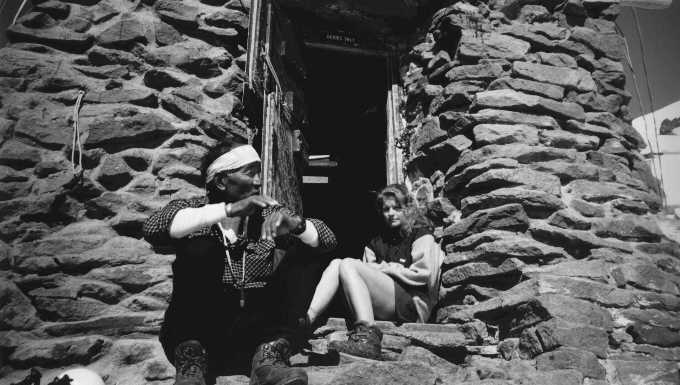
Phursumba and Amberly
The Camp Muir guide cook joined us in our conversation. Amberly Gaul is one of the many cooks that take care of the guides at Muir and also provides the warm water for the clients. She was a young and attractive girl, probably about 24 years old. We all talked for awhile, and eventually Phursumba left to attend to some business. I talked to Amberly for awhile, and I think she appreciated the company, because after awhile she let me take a peak inside the guide hut. I was way too nervous to actually enter the hut. I didn’t feel like I earned the right to be in a place that had housed such famous climbers, plus I didn’t want to get her in trouble, so I just poked my head inside. The names of all the past guides are etched into the wood of the hut all over the place. It was fascinating reading the names of all these people I had read about before. Some of them had died tragically in infamous mountain climbs, and it made me a little sad to see their names. I realized that I would probably be hearing the names of some of our guides in some famous mountain tragedy, and I didn’t like that feeling. George Dunn, one of our guides, had been there when one of the most famous mountain guides had died, a fascinating sounding woman by the name of Marty Hoey. Virtually every mountain climbing book I’ve ever read or mountain climbing video I’ve ever seen has mentioned Marty in some shape or form. George had been there when Marty had accidentally fallen out of her harness as she was climbing Mt. Everest. She had fallen 6000 feet to her death as her friends had looked on in horror. Amberly pointed out Marty’s name to me. The names in the hut were a little too saddening for me, but I appreciated that Amberly let me see them.
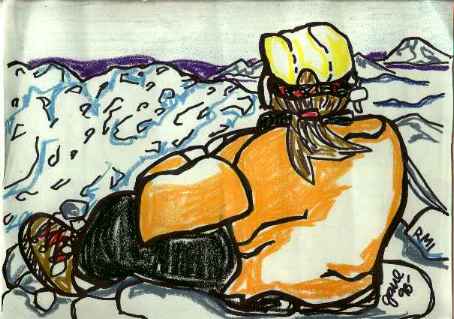
Amberly’s sketch of Daniel
Phursumba came back and we all talked again. Amberly drew a marvelous picture of me as I was talking to them both. I didn’t know it, but she’s a wonderful artist. She even gave me the picture she drew of me. I was very proud of it, and it made the fact that I didn’t summit Rainier even easier to accept. This was one of the reasons why I wanted to start climbing in the first place, to meet nice, interesting people that I wouldn’t have ever met otherwise. Amberly drew a picture of Phursumba too, and I think he really enjoyed it. They were really great drawings, and she even took the time to color them.
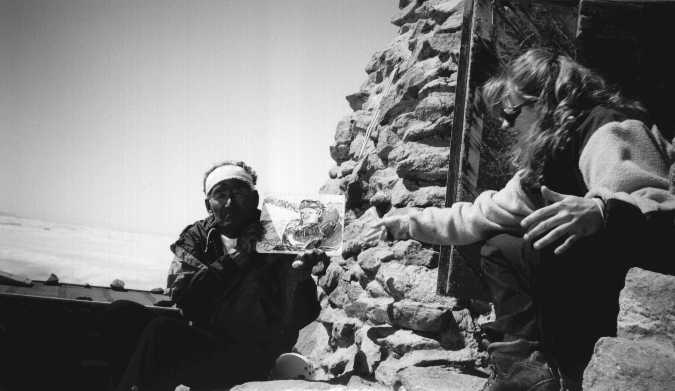
Phursumba posing with Amberly’s sketch
As the day wore on, I took the opportunity to take some pictures of the surrounding area. I walked all over the place and got some nice pictures of Camp Muir and the glaciers all around. At one point when Amberly and Ashley were getting a new supply of water from the ground, Ashley yelled at me to stop where I was. I did. He asked me if I knew where I was. I told him I didn’t, and he informed me that I was on a glacier, right near a crevasse. I didn’t dispute him, and listened to him carefully as he told me how to get out of that area safely. I decided I had enough pictures of Rainier and decided that sitting on the steps of the guide hut was adventure enough for me for the rest of the day.
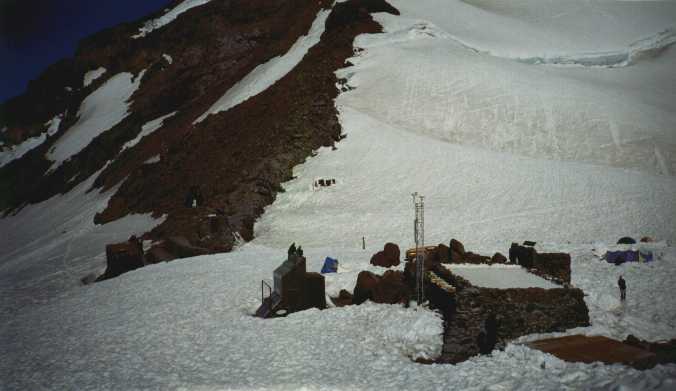
Camp Muir on the left with public housing on the right (the 4 small squares directly to the right and above Camp Muir is the water retrieval system)
After a few more hours, I could see a very small line of climbers at the top of the Cleaver. You can just see the Cleaver through a break in Cathedral Rock called Cadaver Gap. I could see about 20 climbers all moving at a snail’s pace. I knew they’d be down in about 2 hours. I informed everyone at Muir and they all seemed genuinely excited about their return. It was almost like watching family learning of their loved one’s return from war.
Eventually, I saw the first line of climbers descending Cathedral Rock. They slowly approached Camp Muir. I wondered if everyone had made it to the top, especially my buddy Dave. Amberly set off to make them all hot water. I got my camera out and realized I only had 1 picture left out of all the film I had brought. I wanted to get a picture of Dave returning whether he was victorious or not. As each group came back, I felt so proud of them. I still didn’t regret not making it to the top. I thought that was a bit weird, but I think I was just so happy that I had accomplished what I wanted to, and I had gotten the chance to meet Phursumba and Amberly.
All the groups came in, but I still didn’t see Dave. I finally saw one last group descending Cathedral Rock. They took a short cut down the Cowlitz Glacier that brought them precariously close to the large crevasse I had marveled at earlier. I guess they knew what they were doing. Dave was in that group of climbers. I could tell because he had the best fashion of everyone in that group. Dave had told me weeks before as he shopped for his mountain underwear, "It’s all about fashion, Daniel." I guess he knew something I didn’t, because the little bastard made it to the top. Remind me never to invite him on a climb again. I knew I’d get a hard time at work from everyone now. Oh well, at least I got my ass up on the mountain and tried something with my life! As Dave got closer, I got the camera ready for the victory shot. As he stepped over the last little row of rocks, I started to take the picture, but all of a sudden Dave stumbled and fell face forward. I couldn’t take the picture; that would have been way to mean. As he was starting to stand up, I thought screw it, and fired off my last picture.
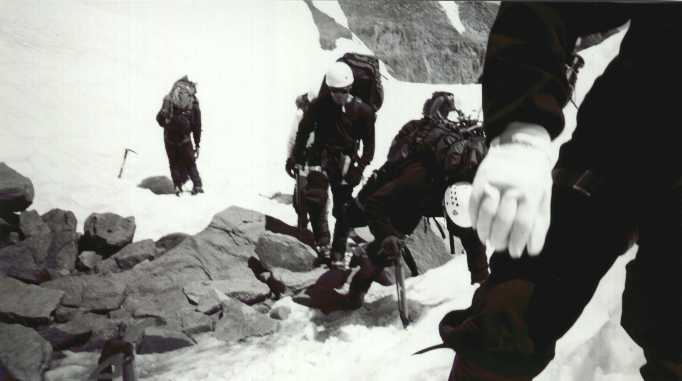
Dave’s somewhat triumphant return
I talked with a lot of the climbers and listened to their stories. I talked with Dave and when we were both alone he told me how hard it had been to get to the top. I wanted to hear every detail, but we were all being urged to get going. He did tell me one interesting anecdote that has to be the funniest thing I have ever heard. He said as he was getting to the top of the Cleaver, around 12,300 feet, he all of sudden got the biggest urge to poop. He said it built tremendously as he ascended more, and he fought the urge by releasing a little of the gases that are normally meant to help with the extraction. He said he knew the climbers behind him probably hated him, but he didn’t care. He wasn’t even really feeling any of the affects of the altitude, because he was too concerned with crapping his pants. He barely made it to the top of the mountain without an accident, but knew he had to do something immediately or risk an emergency no one wanted to witness. He asked one of the guides for a blue bag. We are all required to pick up after ourselves if we relieve ourselves on the mountain, because things don’t decompose at that altitude, and the blue bags are what we were supposed to carry our waste in. The guide gave it to him and told him to just pick it up and carry it to Camp Muir where they have buckets to put it in. He said he ran to the nearest rock that he could hide behind, and before he could really get his pants all the way down, he crapped all over the place in the largest explosion this side of St. Helens. I had given Dave a large section of my toilet paper roll I had brought with me, but he didn’t know where he had put it or even if he had packed it, so he bit the bullet, grabbed a handful of snow and wiped as fast as he could. He then stood up and tried to relieve himself the other way, but as most people know the cold has some affects on guys that are a bit embarrassing. He couldn’t find what he was looking for exactly as the portion of the male anatomy that is crucial to this procedure was hiding from Dave. He finally gave up his search and just went. Whoever said never to pee in the wind, should also have said to never pee if you aren’t sure where you are aiming. Dave said with the wind up there and the lack of pee-coordination, he was basically just standing in a warm mist of urine until he finished. Realizing that climbing down the mountain with watery poop on his hand and urine all over himself would not be very fun, not only for him, but also for the other climbers, Dave got on the ground and started rolling around in the snow to clean himself off. He must have been quite a site. I’m sure if anyone had witnessed this, they would have thought he had lost it up there. He then grabbed his blue bag, which you put you hand in to, grab the waste, then invert the bag and seal it. As he told me his story, I could barely stop laughing, and just near brought on that freak asthma attack the Air Force was worried about 9 years ago. I couldn’t stop for a few minutes, but we had to get going, so I figured I’d ask him to tell it to me again later.
Before we left, I went over to Amberly and thanked her again for the picture. She told me she had an exhibit that just started in Seattle with more paintings. I asked her where, and she gave me the street names. I don’t know Seattle at all, but I memorized the names, so I could try and stop by there the next day if Dave and I had time.
We all descended from Camp Muir as an unorganized bunch of lunatics, but after every thousand feet or so, Heather would round us up as best she could and we’d continue down the mountain. We descended at a break-neck pace, and that’s the only time I actually hurt myself the whole climb. We were essentially running down the mountain, slipping and sliding all the way down. The next day, my ankles and legs hurt like I’d never felt before. I sure wish we could have slid down that part of the mountain on our butts.
About 7000 feet, we all had to get in a single file line to descend the rest of the way. We were still descending at a super fast pace, but I was excited about getting down to call my wife and my mom, so I didn’t care. At one point, we were all going really fast, and the lead person stopped rapidly for some reason. We all had to follow suit, which isn’t very easy to do because you have tremendous momentum going forward with the pack on your back. I stopped, but my foot was on the edge of some broken shale, and I fell forward hard. I flipped myself around to catch myself, but my pack was so heavy, it flung me around a full 360 degrees, and I somehow ended up on my feet, heading the direction I was originally heading. Heather yelled out, "What the hell was that Daniel?" Damn it. That was really embarrassing. She wasn’t mad at me, she had just been witness to something more spectacular then an Olympic skater’s final pirouette. I knew I’d never go on another climb with her after that display of coordination. Dave was right behind me and witnessed the whole thing. He said it actually looked really cool. I didn’t know if he was just trying to make me feel better or not, so I asked him again later that night, and he told me again how natural it had looked, so I didn’t feel as much like a dumb-ass.
We continued down the mountain, and it became increasingly difficult to keep my footing on the snow and loose rock as we flew down the mountain. At some points, there are actual steps that you descend, and it’s very hard to gauge where you foot is on each step at the speed we were going and with the large boots we were wearing, so it’s very easily to slip on the steps as you are descending. At about 6500 feet we rested one last time, and we noticed Nancy, the climber who had left the group at our first rest area on the way up, climbing up the mountain. She came over and said hi to the group. It was nice seeing her. She was still on Rainier, practicing everyday, so she could one day get up to Camp Muir and beyond.
As we got below 6000 feet, there were tons of tourists playing around on Rainier’s lower slopes. We must have looked and sounded like a group of soldiers returning from battle. We walked pretty much in step, clicking our ski poles on the rocks, stomping our boots on the ground, and we all looked horrible. It felt pretty awesome, because as we passed these people, they stopped to watch us. Some of them asked us questions that none of us had the energy to answer, some of them just clapped, some of them pointed us out to their children and explained to them what we had just done, and some of them just videotaped us. We felt pretty special, and I guess to them we were, because we had gone someplace very few people actually get to see or experience.
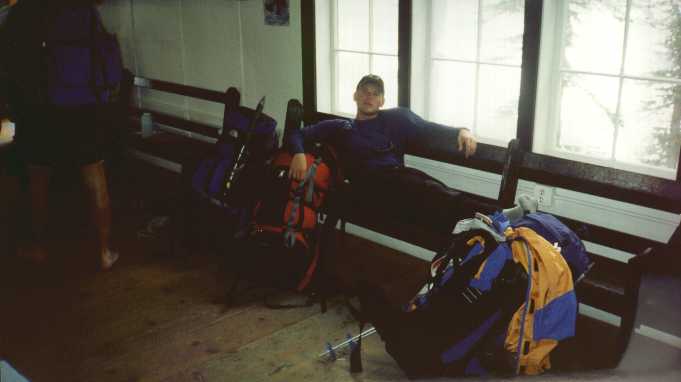
Dave after descending Mt. Rainier
We got back to Paradise and the guides sat us down for a second. They told us some nice words and told us that no matter how bad we felt and how much we hated the mountain, we’d all be dreaming of our next climb in a few days. They said that’s how you can tell if you are a true climber or not. If you climb something like that, and it kicks your butt, and you have a miserable time, but a day later are wanting to get back on it, then either you are insane or you are a climber. We eventually all said our good-byes and parted ways. Most of the climbers got their summit certificates, proving that they had made it to the top of Mt. Rainier, but I just went right to the phone and called my wife and told her in a few sentences, "Hey Kim, I’m alive, we’re down, I didn’t summit. More later," and then I said good-bye. I was ready to collapse. Some of us agreed to meet a little later for beers, so Dave and I went to our room to freshen up. We both fell on our beds and didn’t wake up for a while. We eventually did get up and started to get ready to go and meet the other climbers. I took a quick bath, and I have to say it was by far the best bath I’ve ever taken in my life, both physically and emotionally. I had been training so much for this climb, and now it was over with. It was past me, and I had accomplished what I had set out to do. At my job, I don’t get to feel accomplishment very much because our projects take a few years to finish sometimes, so working for a year getting ready for this climb, then succeeding at what I wanted to do, felt like I had really done something important in my life.
I got out of the shower, and Dave was going through his pack. All of a sudden he started laughing hysterically and didn’t stop for some time. I asked him what was wrong, but he couldn’t stop laughing. He reached in his pack and pulled out a little blue bag that was sealed as well as it could be at 14,411 feet. Dave had brought home a souvenir by mistake that neither of us wanted to take back to Chicago.
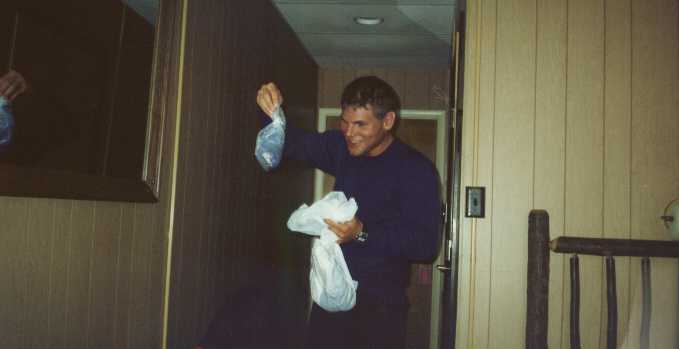
The infamous blue bag
We missed the other climbers, and Dave had forgotten to get his summit certificate. The guide hut was closed for the night, so we just went and ate a good meal at the Paradise restaurant. We were both buzzing with satisfaction of a job well done, but we were both exhausted. I knew no matter how I felt, Dave must be 5 times worse. He went 3000 feet past where I collapsed and had to descend that distance as well. For that night, Dave was my hero. I have no idea how he made it to the top of that thing, but I was happy as hell that he did.
When we arrived inside Paradise, I did the thing I promised someone back home that I would do first when I returned from the mountain. I called my mom. Her worries were now gone, and I think she was actually excited to hear about the climb. Too bad I didn't have the energy to tell her about it. I got off the phone and called the other important lady in my life .. my wife. That phone call was even shorter, "Hi babe, I made it. I'm going to sleep. Love ya." And I was off.
We went back to our room and crashed for the night. We woke up the next morning sore as hell, but content that we were going home. We got the car packed, and went over to the guide hut to try and see if Dave could get his summit certificate. It was crazy in there as a new bunch of climbers were getting ready for the summit school. Those guides are amazing because they do this for a living. This one climb kicked my butt, and these guides go up and down this mountain almost every day. Dave succeeded in getting his certificate, and as we were leaving we noticed a very attractive blonde that seemed to recognize us. "That’s Heather," I said to Dave. Heather had her hair down for the first time the whole climb and was wearing normal street clothes. We both went over and said good-bye. Dave asked her to sign his certificate. I think she was flattered. As she signed her name, Dave told her that he was sure we’d be reading about her someday. I’m sure we will.
We got to Seattle and eventually did find Amberly’s art collection. It was a wonderful exhibit at a nice bar, and Dave and I were both proud of our orienteering skills. We played a few games of pool that took about an hour a game (we both sucked that day for some reason), and headed off for the Seattle/Tacoma airport. We had about 4 hours to wait for our plane, which would take us to Phoenix, and then to Chicago, so we wouldn’t get home until 2 am the next day. We both had to go to work that day, so we asked the ticket agent if there was an earlier flight. They said there wasn’t and that our flight was delayed. We wouldn’t be getting home until much later. The lady told us to wait a second, and she made a phone call. She said she had called another airline and they had a flight leaving in 30 minutes that flew directly to Chicago. We’d get home before 9pm that night and not have to pay a cent more! I wanted to kiss the lady I was so happy. We were both ecstatic, and thanked the lady more times then I think she cared. We rushed off to our gate and walked right on our plane.
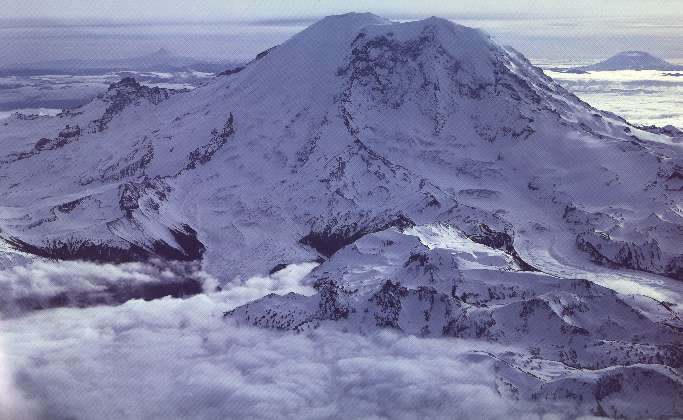
As we took off from the airport, the pilot announced that we’d be flying past Mt. Rainier in a few minutes. It would be out the right side of the plane. Dave and I had happened to get seated on that side, so we were both excited to know we’d get one final good-bye before heading home. After a few minutes, Rainier did in fact come into view and it was spectacular. If you’ve never flown into the Seattle/Tacoma airport, you are missing something very special. Mt. Rainier is a huge mountain, exacerbated by the fact that there is such flat land all around it for hundreds of miles. We sat in awe as we flew past it. We couldn’t quite see the area we had been, because we were now on the north side of it, but realizing that there were climbers on it, trying to reach its summit made me feel like I had participated in something special. As we passed the mountain, we did catch a glimpse of one area we had been, and that was incredible being able to recognize that so easily from that far away. I remembered how miserable I had been on the climb, but it was hard to dismiss the good things about the climb. As Mt. Rainier went out of view, I realized I must be a mountain climber, because I was ready for the next climb. Either that or I’m insane.